
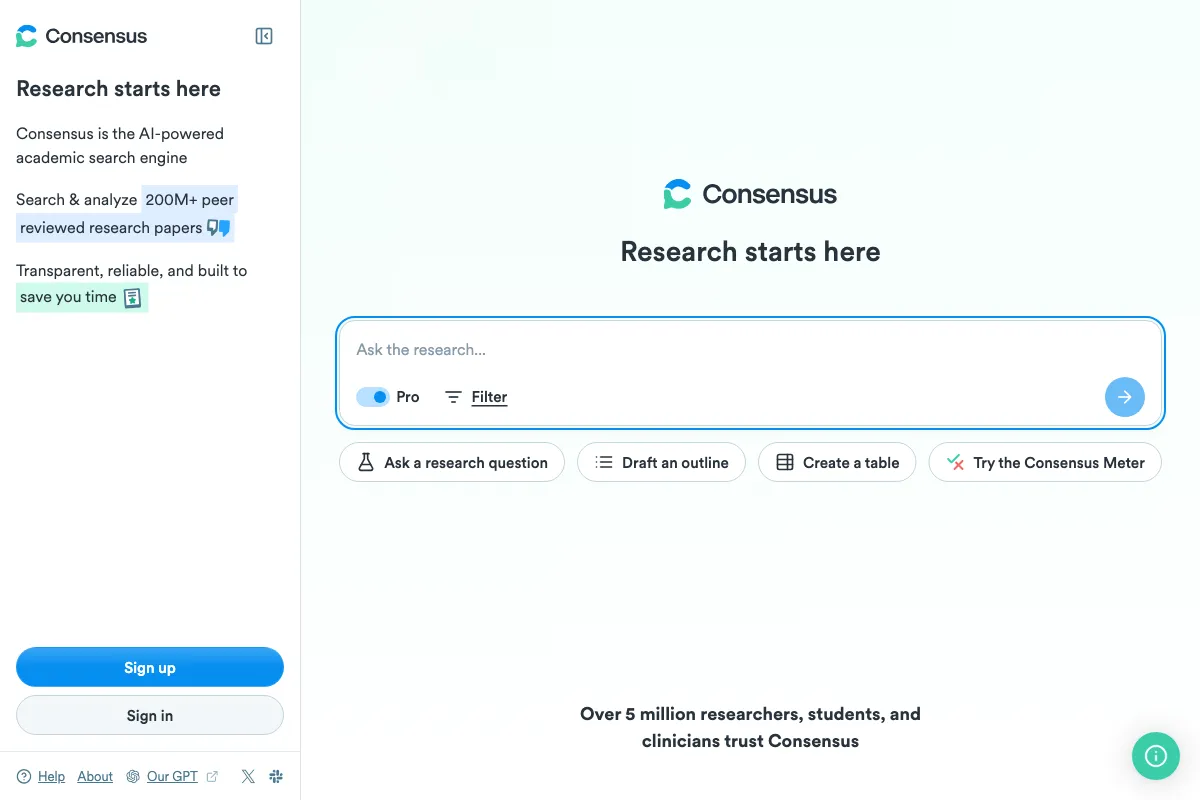
Consensus is a research tool for people who need to find and assess academic evidence without treating a broad web search as the whole answer. It searches scholarly papers, synthesizes retrieved studies into responses, and includes citations so readers can inspect the underlying work. Researchers, students, clinicians, and research teams can use it to explore questions, compare findings, and organize papers. It is designed to make literature discovery and review more structured while keeping the papers behind an answer in view.
Rather than presenting a claim without a trail, Consensus connects its answers to retrieved research. Readers can use it to move from a question to relevant studies, then examine what those studies report. Its research tools cover both discovery and follow-up: users can investigate authors and citations, compare papers, and organize saved material for continued work. The product is intended for evidence-seeking tasks, not as a replacement for evaluating the methods and context of the papers themselves.
What can Consensus do?
Consensus searches academic literature and provides synthesized answers with citations to the papers it retrieves. For yes-or-no questions, the Consensus Meter summarizes whether studies support, oppose, or are inconclusive. Pro answers analyze a selection of papers, while Deep can run parallel searches and read a larger set of papers. These tools offer different approaches to reviewing evidence, depending on the question and the depth of analysis needed.
Research Agent supports multi-step workflows such as citation crawling, author search, comparison tables, and research-gap analysis. Study Snapshots extract details including methods, sample or population, duration, location, outcomes, and results. Citation Grounding exposes quoted passages and their locations behind AI citations, and Citation Graph maps relationships among papers. Library organizes papers and searches into collections, supports eligible document uploads and Zotero imports, and lets users search or chat across saved material.
- Use Medical mode to search medical papers and clinical guidelines.
- Ask evidence questions and inspect the cited studies behind synthesized answers.
- Use Study Snapshots to review study design and reported outcomes.
- Connect academic search to external applications and AI clients through API and MCP access.
Who is Consensus best for?
Consensus suits people whose work involves finding, comparing, or organizing research literature. Students and researchers can explore a topic, follow citations, or compare papers. Clinicians can search medical literature and guidelines, while research teams can use shared administration and centralized billing on the team offering. Readers who need to check how a response relates to its source papers may value citation passages and paper-level details. It is less suited to someone seeking a general-purpose answer without a need to inspect academic sources.
Consensus pricing in brief
Consensus offers a free version and paid tiers for individuals, teams, and organizations. Included research allowances and API or MCP access differ by tier. The free version has set allowances for AI-assisted messages, Deep reviews, Study Snapshots, and API/MCP calls; paid tiers expand some of these allowances, and organization plans add administrative or support options. Review the plan details to compare included usage and applicable API limits.
Limitations to know about Consensus
Free access does not include unlimited AI analysis, and API/MCP access has plan-specific ceilings. Self-serve API plans are limited to one request per second; paid overage charges apply only within the stated plan ceilings. Library uploads must be text-based PDFs below the file-size limit, so scanned or image-only PDFs cannot be processed. Zotero import is manual and one-way, and externally linked files are not imported for search and analysis. Synthesized answers should be checked against the cited studies and their methods.
Alternatives to Consensus
Elicit is an alternative for research discovery and literature review workflows, while Scite AI offers another way to investigate scholarly citations. Research Rabbit can help readers explore connections among research papers. These tools overlap with parts of academic discovery and citation exploration, but their features and workflows differ. Compare how each handles search, paper analysis, and organization against the needs of your research task.


